


Olga Mangold
OLGA Mangold, Arčipa meita | daughter of Archipa
21.10.1891 (02.11.1891) Tāšu pagast — 23.12.1978 (age 87), Rīga, Lāčupes (Lācara) kapi.
Husband:
Nikolajs Ferdinande Lepshe, 20.07.1895, Paurupe, Rucava, Latvia — 19хх Australia
Children:
Lilija Lepshe (31.07.1934 Liepaja — 21.09.2020, age 86 years, Australia)
Arvids Lepshe (31.07.1936 Liepaja — хх Australia)
Residence:
1914 – Rīga
1918 – Ukraine, Odesa
1919 – Rīga, [Behrzu] iela, 7, dz.2
1931 – Rīga, Brīvbas iela, 93, dz.18
1931 – Rīga, Raudes iela, 17, dz.1
193x – Rīga, Dzirnavu iela, 113, -13
1935 – Rīga, Raudes iela, 17, dz.1
1939 – Rīga, Biežu iela, 6, dz. xx
1945 – Rīga, Biežu iela, 10, dz. 2
1950 – Rīga, Biežu iela, 10, dz.2
1950 – Rīga, Biežu iela, 10, dz. 6
1978 – Rīga, Biežu iela, 10, dz. 9
BIOGRAPHY
1891
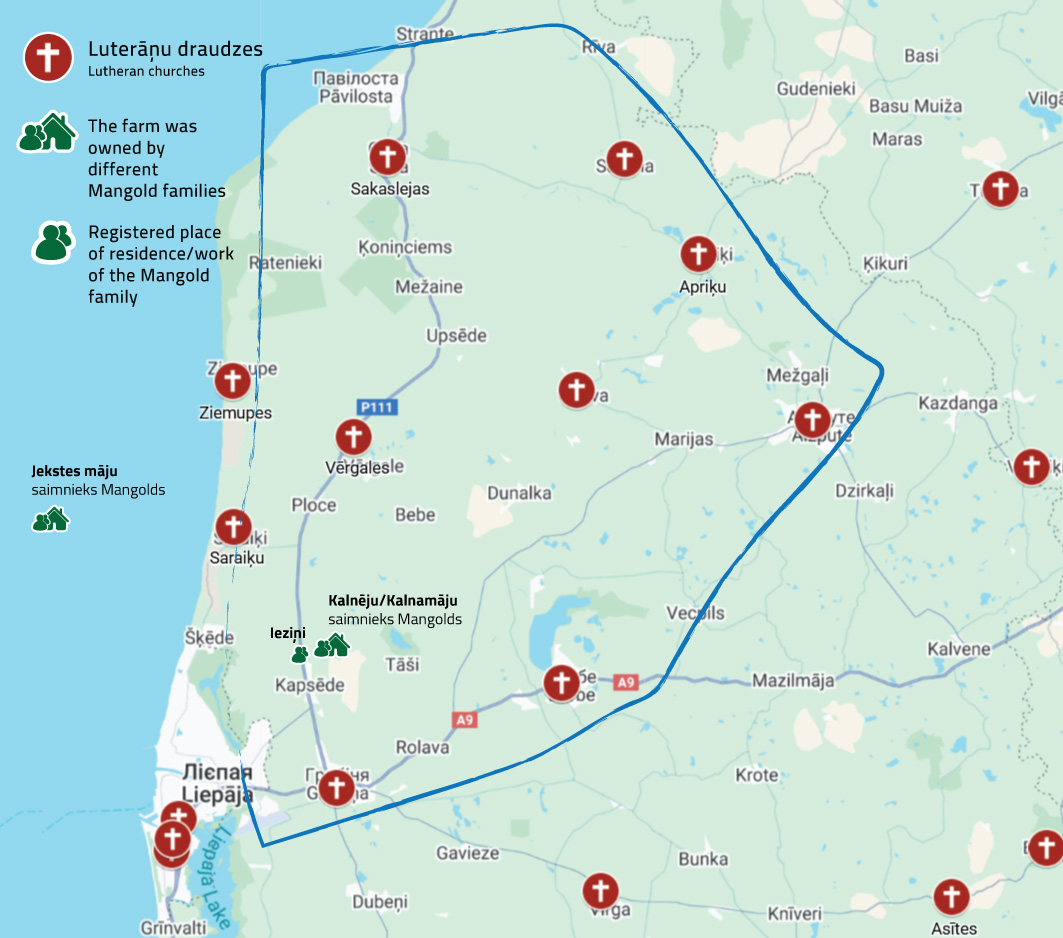
Olga was born in 1891 in Talsen Parish of Grobin County (Tašu [Tashu] pagast, Grobiņas apriņķis). The only known fact about Olga’s origin is her father’s name, but the search and research continue, and sooner or later we will learn about Olga’s family, where they came from, and whether she had brothers and sisters. For now, I will only add that Tašu pagast, or more precisely the whole area from the ancient town of Grobiņa to Aizpute, is also the small homeland of her future husband’s family, the Mangolds, who had lived there at least since the early 19th century.
1914
Where and under what circumstances Olga met Karl is unknown, but they likely knew each other since childhood. In any case, after the death in 1911 of Karl’s first wife — Maria Mangold (née Vinter) — when he was left alone with two boys, my grandfather Karl and his younger brother Heinrich, he married Olga sometime between 1912 and 1914.
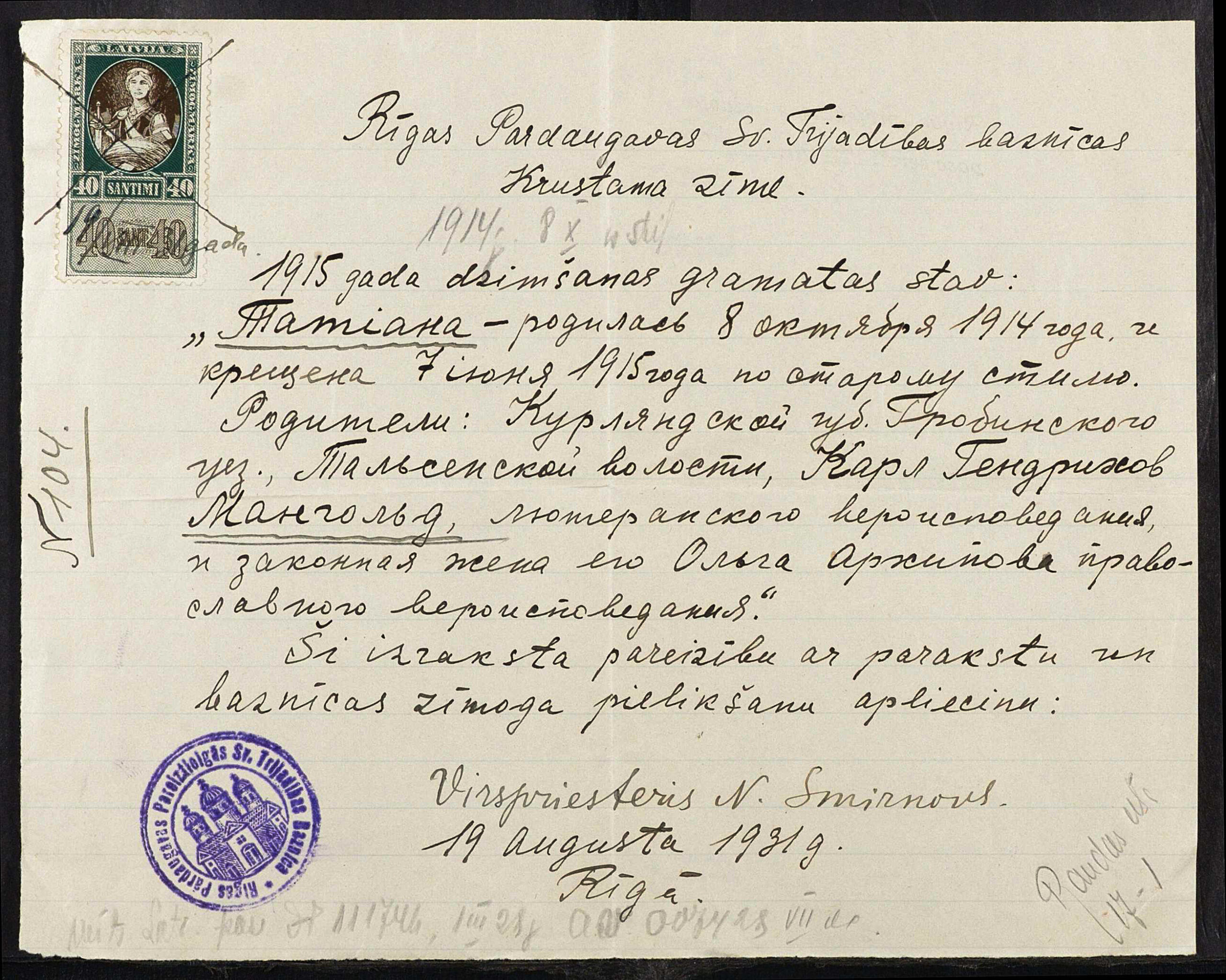
On October 8, 1914, the couple’s daughter Tatiana was born. On June 7, 1915 (Old Style), she was baptized in the Riga Holy Trinity Church. The parish records state: father, Karl Heinrich Mangold, Lutheran, from Courland Governorate, Grobin County, Talsen Parish, and his lawful wife Olga Arkhipovna, of the Orthodox faith. This last fact — that the mother, who baptized her daughter specifically in an Orthodox church, was recorded as Orthodox — complicates the overall picture, since in all later documents both Olga and Tatiana are listed as Lutherans.
1916
In the archives from the 1910s, there is a reference that Karl Mangolds worked at the Riga Tram Depot. Presumably, it was together with the Tram Depot enterprise that in 1915–1916 the entire Mangold family — Karl, Olga, and their three children: Karl, Heinrich, and Tatiana — ended up in Russia as refugees. In 1916 they were sent to Odessa.
Historical context. During the First World War, during the retreat of the Russian army, more than 500 enterprises of Latvia were evacuated to the territory of the Russian Empire. Part of the property of the Joint-Stock Company “Riga Trams” was also evacuated: equipment, rolling stock, and railway tracks. Enterprises were evacuated, whenever possible, together with their staff and their families. /Coming soon/ Article on the plundering of Latvia by Russian and German troops in 1915–1916 >
After the end of the First World War, the Mangold family prepared to return home, but certain dramatic circumstances prevented this — circumstances we will never know.
Most likely, in 1918 Olga’s husband, Karl Mangold, was mobilized — either into the Red or the White Army. In any case, in 1919 Olga returned to Latvia with her daughter Tatiana, where on 05.08.1919 she received in Riga an Identity Certificate No. 7746 and settled at [Behrzu] iela 7, apartment 2.
Why not all the children returned remains a mystery. Most likely, the boys, who at that time were 16 and 17 years old, stayed on to continue their studies and waited for their father. Soon the “window of opportunity” closed — and leaving Russia became impossible.
Karl the elder went missing, most likely in 1918. In 1938, during the arrest of his son Karl the younger, the NKVD found correspondence with Olga Mangold. The investigators were interested in who Karl was corresponding with in “bourgeois” Latvia. In a postcard, Olga Mangold asked whether there was any news about her husband Karl. At the interrogation, Karl replied that his father had died in Kuban in 1918. I do not know whether this was true, since in the same interrogation Karl lied about the whereabouts of his brother Heinrich and in fact saved him from persecution. /Coming soon/ Article on the operation against repressed Latvians (NKVD cipher telegram No. 49990 of 30.11.1937) >
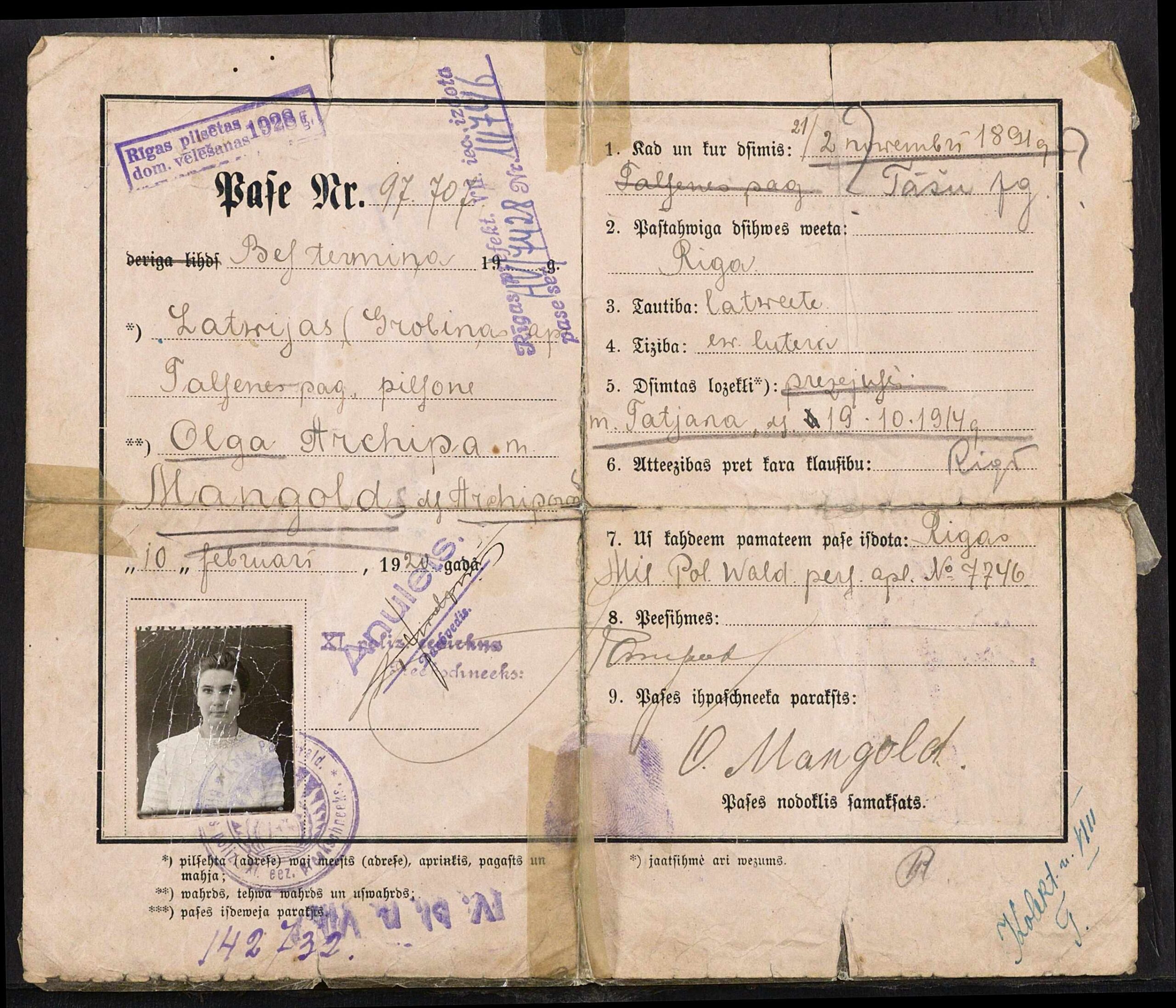
1920
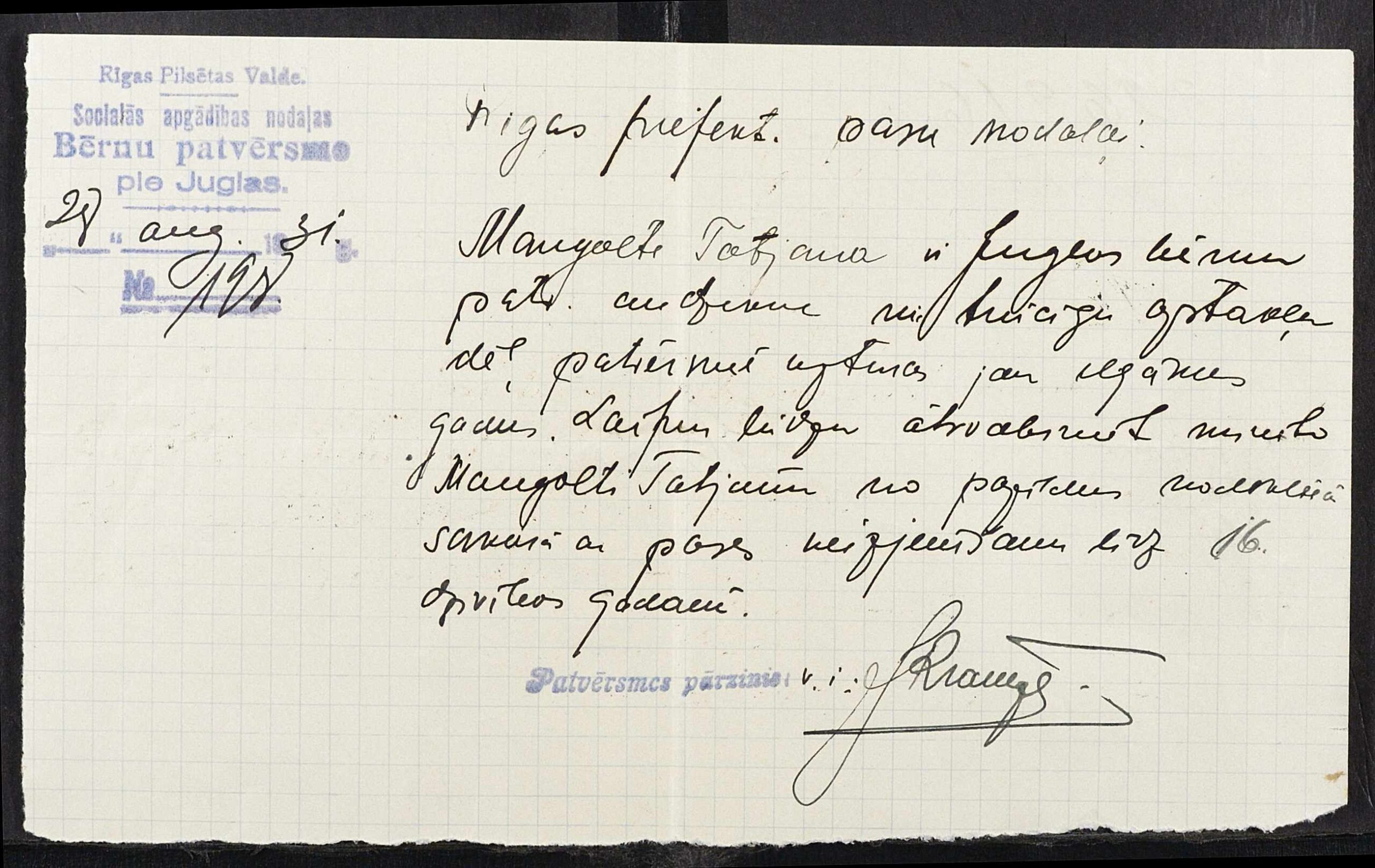
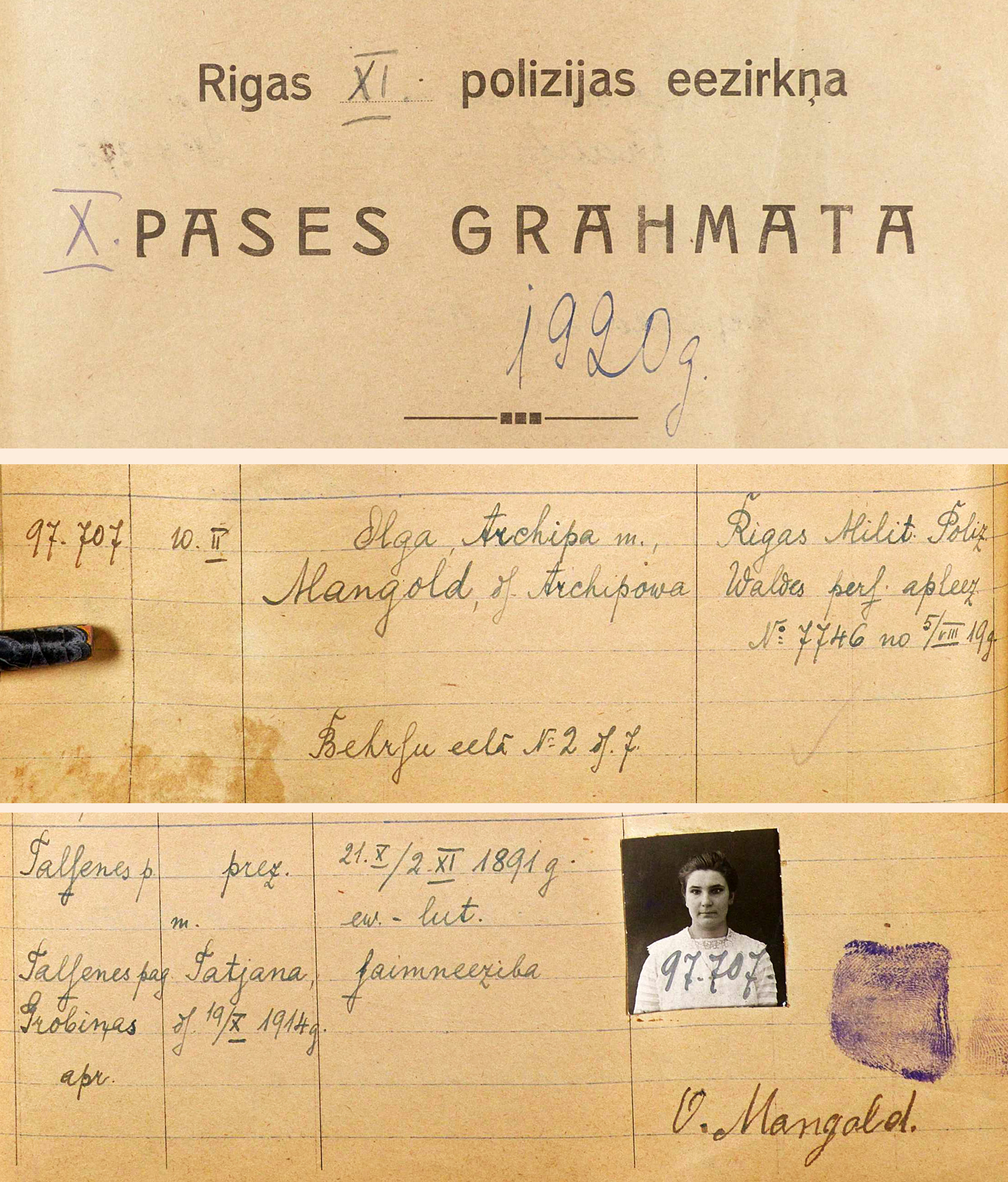
On February 10, 1920, Olga Mangold received a Latvian passport. Tatiana was already 6 years old and attended school at Miera iela, Riga. A little later, Olga placed her daughter in the Children’s Home (boarding school) in Jugla at the address Jugla (Riga), Strazdumuiža No. 4. Until 1931, Tatiana lived and studied in Jugla, which at that time corresponded to the most modern pedagogical and educational standards.
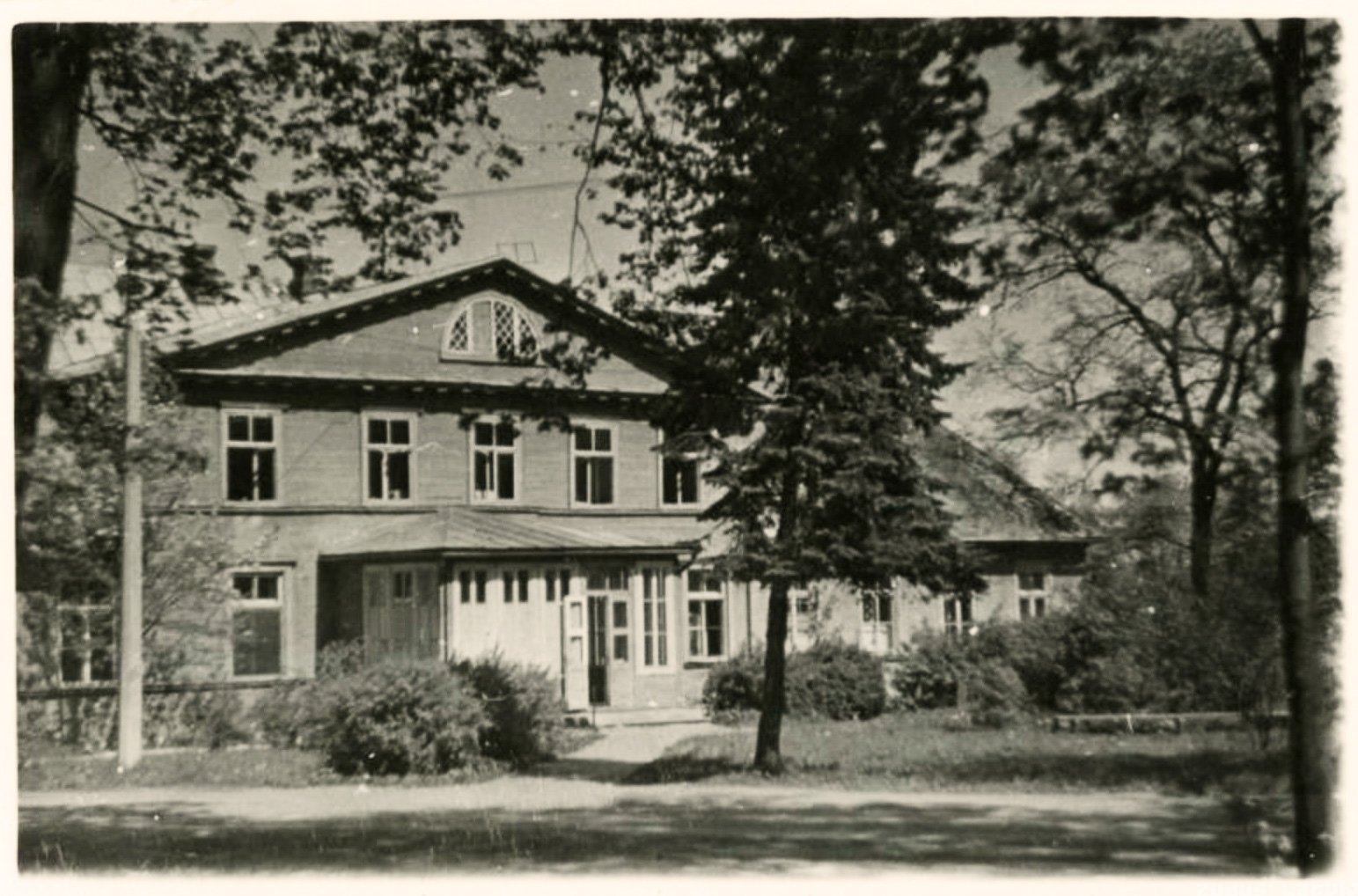
Jugla (Rīga), Strazdumuiža №1
1939
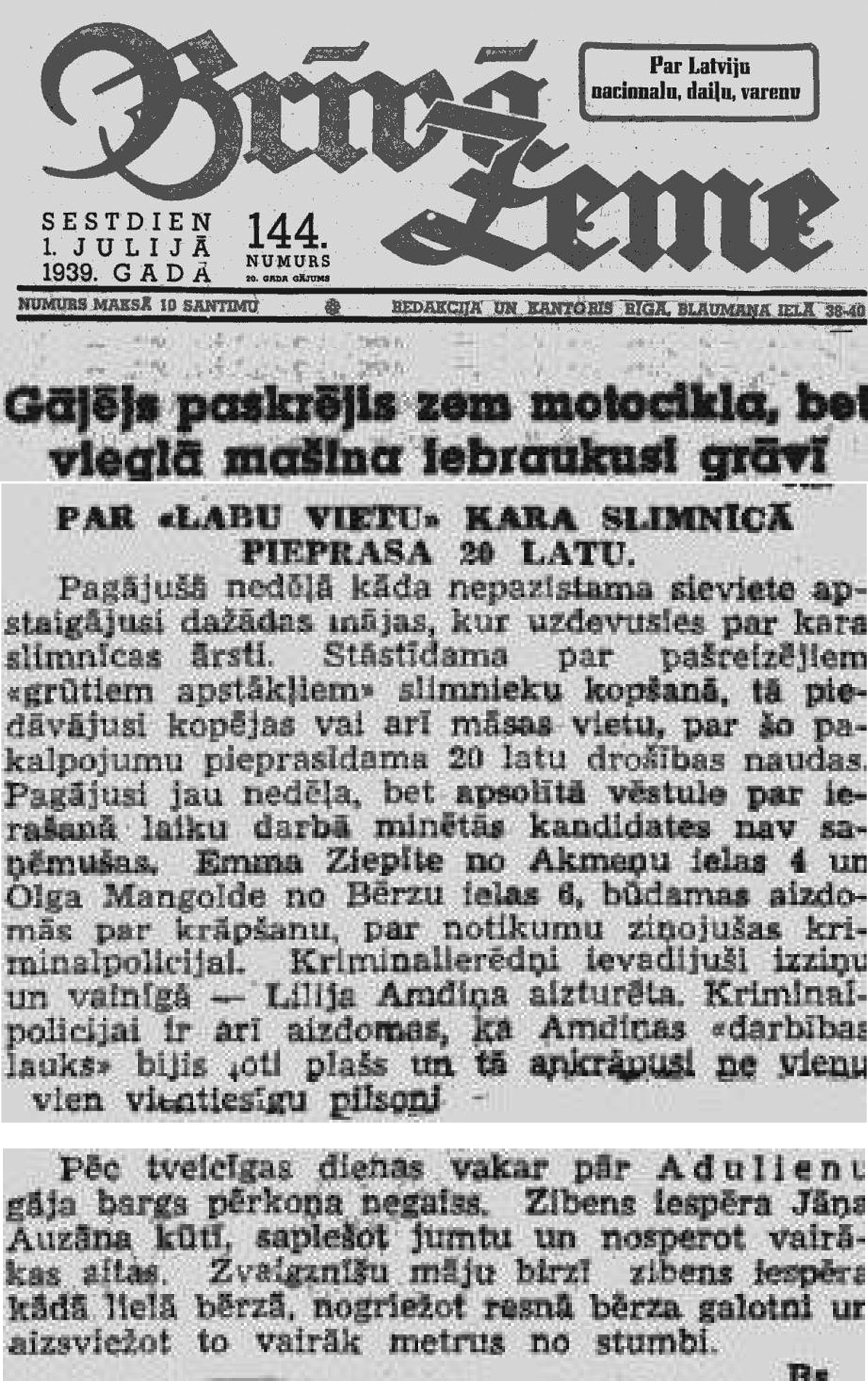
In the newspaper Brīvā Zeme (“Free Land”), No. 144 of July 1, 1939, there is a note in which Olga Mangold appears as a victim in a fraud case.
FOR A “GOOD POSITION” IN THE MILITARY HOSPITAL, 20 LATS WERE DEMANDED
Last week, an unknown woman went around various departments, pretending to be a doctor at the military hospital. Speaking about the “difficult circumstances” of caring for patients, she offered a position as a nurse or attendant, demanding a 20-lat advance payment for this service. A week passed, but the promised acceptance letter for employment was never received by the mentioned candidates. Emma Ziepīte of Akmeņu iela 4 and Olga Mangold of Bērzu iela 6, having been deceived, reported the fraud to the criminal police. The criminal agents started an investigation, and the culprit — Lillija Arniņa — was arrested. The police also suspect that Arniņa’s “activity” was quite extensive and that she had already deceived more than one trusting citizen.
After a hot day, in the evening, a strong thunderstorm passed over Aduliena. Lightning struck the granary of Jānis Auzāns, breaking the roof and damaging several beams. In the estate of Zvērģrāfija, lightning struck a large birch, cut off its thick top, and threw it several meters away from the trunk.
1978
At 6 Bērzu iela, Olga Mangold lived through the Russian, German, and again Russian occupation. Until the end of her life, she corresponded with her daughter Tatiana. Unfortunately, I have found only one letter of an unknown year. Tatiana’s daughter wrote to Latvia, beginning it with the words: “Hello, Mama.”
Olga Mangold was buried on 23.12.1978, at the age of 87, in Riga at Lāčupes Cemetery. The burial was arranged by S. Ķire (S. Kire), who lived at the address: Riga, Meteora iela 10-5.
The research into the fate of Olga Mangold does not stop. By the way, there is an interesting coincidence concerning the mysterious S. Ķire. In Tāšu pagast, the place of origin of both Karl and Olga, on 14.09.1894 a certain Anna Ķire (Kire, Dreimane) was born. And there is another coincidence. In 1958, a journalist and freelance correspondent of the newspaper Padomju Karogs (“Soviet Flag”, No. 93, 09.08.1958, Talsi) published a small note about the kolkhoz worker Püteris Irbe, who harvested a crop of winter cereals from 10 hectares.
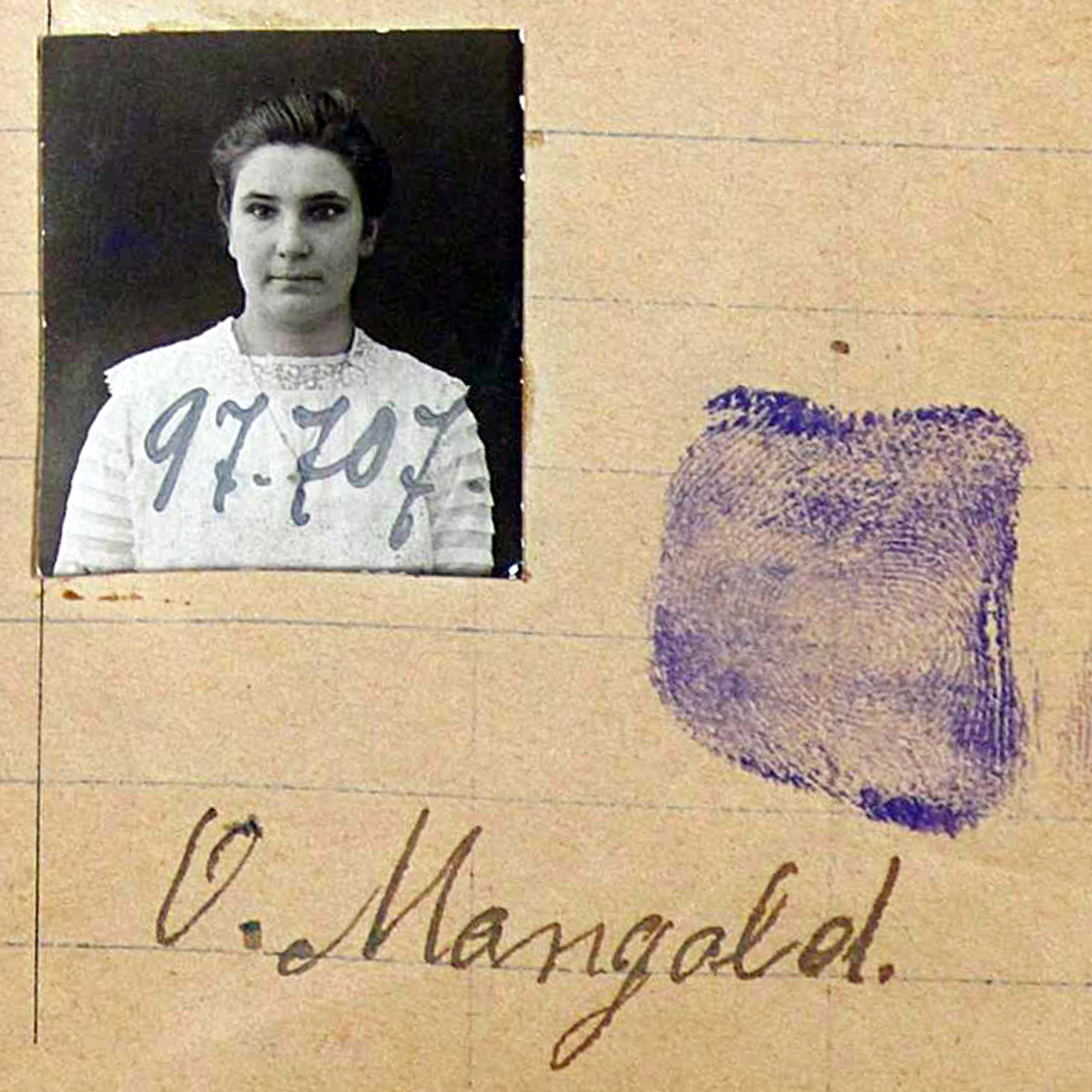
Olga Mangold, 1920, Riga
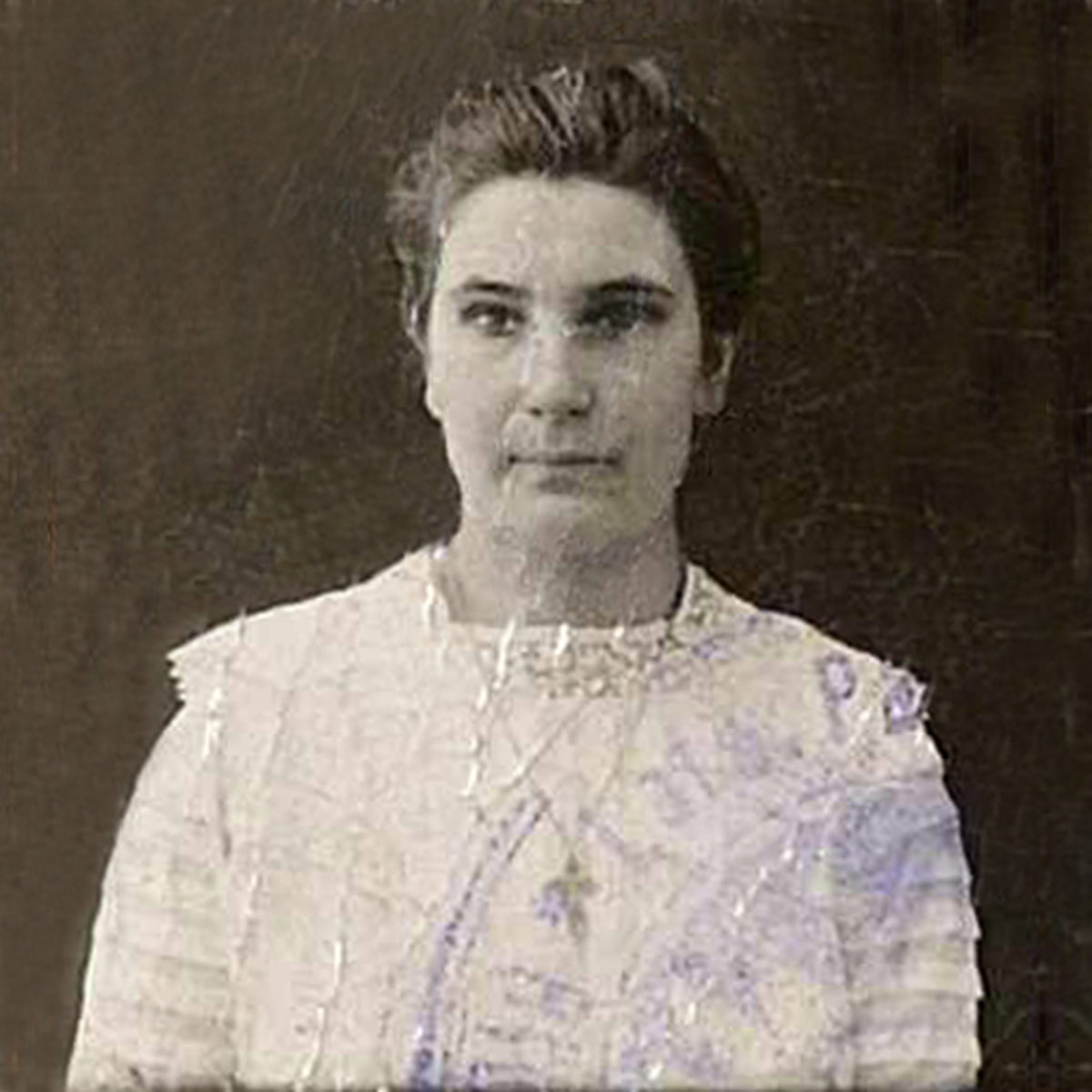
Olga Mangold, 1920, Riga